A Coinage to remind us of our origins
Maria Cristina Casanova
During the seventies and the eighties, the feminist movement in the United States and in Europe, managed, if in different ways, to create something which many women experienced as a common territory, a common identity; the embryo of that "common world of women" described by Adrienne Rich, whose ideas had been influential in Italian feminism.
"Women both have and have not a common world. The mere sharing of oppression does not constitute a common world (...) Our history is the history of a majority of the species, yet the struggles of women for a "human" status have been relegated to the footnotes, to the sidelines. Above all, women's relationships with women have been denied or neglected as a force in history. (...) For spiritual values and a creative tradition to continue unbroken we need concrete artefacts, the work of hands, written words to read, images to look at, a dialogue with brave and immaginative wo-men who came before us (...) wo-men in patriarchy have been withheld from building a common world, except in enclaves, or through coded messages"(1)
We were experiencing life in the women's movement as the embryo of a new kind of social existence which was nourished by our mutual exchanges. Many women, often artists, wished to discover- or rediscover- a connection to a sense of the "sacred" which belonged to us. The need was felt for a sense of the female divine which should be collective and public.
In the early 70's, the American theologist/philosopher Mary Daly, had attempted in vain to speak to men within the Catholic Church. Then, during a solemn religious ceremony, where she had been invited to speak as the first woman preacher, she made her historic gesture of inviting the congregation leave the Patriarchal Church. Many literally walked out of the building under the "astonished" eye of the television camera.
In 1985, the French philosopher Luce Irigaray, higly esteemed in Italy, wrote: "In order to gain access to social organization, women need: a religion, a language, a coin of exchange or a non-mercantile economy (...) although the desire exists to establish a new kind of sociability, we still have to live in the existing one: a sacrifical, technical, technocratic society, created and governed by men. This is truer than ever before. How can we establish amongst ourselves certain rites which will help us to inhabit this society and to become women to our fullest extent? How can we create systems of excange among ourselves? I know of no society which flourished on an exchange between women.
Pherhaps it exsisted a long, long time ago? Pherhaps it still exists, far from here? But where are the traces of a currency among women? And of a Divinity among women?"(2)
It was against this background that a group of Bolognese artists, "Prophetess and Sybils", developed their work in the eighties, ouside the official circuits, creating images and words which would form a novel world and open pathways towards other women who share the same passion.
New Sacred Writings were born:
"Beyond the Apocalypse", a prophecy metaphor for a hypothetical female Hooly Book, which opens the first chapter of new civilization destined to overcome patriarchal dominion:
And the MOTHER told me:" Go, and may your cry resound everywhere. May it be louder than the voice of the storms and the howling of the ocean. May it be in harmony with the voice of the waterfalls and with the chant of the rivers. May volcanoes be mute in front of it.
You will not shed tears but of joy, since you knew my power. My power is your power. Yours, and of my beloved daughters. Those who deny me not. Your voices will flow as streams from the mountains, will join and become a wide river.
The people of Judith listened to Judith and were safe
The people of Cassandra didn't listen to Cassandra and were destroyed.
If the people of the earth will not listen to you, everyone and everything will be destroyed."
"Genesi per divina fanciulla", the writing of a new Genesis:
"In Principio era il caos: ma la Madre
era presso la Figlia e il verbo presso di loro
e neppure una delle cose create senza la loro unione è stata fatta:
in esse era la vita e la fine della vita il moto
così che nella luce l'ombra e ombra è luce
né delle Tenebre nessuna avrà mai più paura..."
We had a passion for transcendence, but we also felt the burden of immanence.
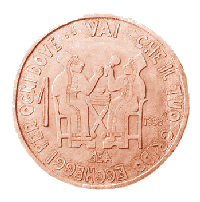
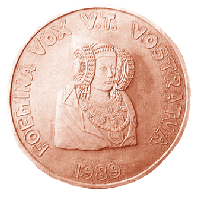
A coinage to signify the value of this foundation of civilization
A coin: *Gea, to remind us of our origins
All this vital turmoil, which passed unnoticed by those who where not immediately involved, gave rise to gradual transformation, generating wealth for the next generations, which gained benefit from it though unaware of its origin, wealth which was sometimes understimated and forgotten by the very women who had produced it.
What happened to the feminist mo-vement was the same kind of "bla-ck-out" which, as if by some ineluctable destiny, sistematically cancels from the collective consciousness of women and men the presence and value of that female action which gives birth to and sustains all human society, thus depriving women themselves of the awareness of their own potential, burying women's perception of themselves and their action in a timeless, weightless limbo. How, then, could we make visible and tangible the existence of those precious excanges which were taking place, and take place, between women, how, then, could we bring their value to light?
We chose the brightness of copper, silver and gold minted as coins with female significance: the Gea was minted in Bologna in 1990.
According to Unesco figures in 1983, women make up 50% of the world population and a third of the official work force, carry out two thirds of total effective work, but receive only the tenth of the world income and possess less than one hundredth of world property.
Most of us have problems with money, with requests for payment; Contracting money for ourselves is perceived as the breaking of a social taboo.
Money is in fact unconsciously felt to be a kind of secondary sexual characteristic of the male, almost a symbol of his ancestral right to establish the hierarchy of social values.
Putting a female coinage into circulation means recognizing the existence of a world of values established and agreeded upon by women, means providing this world with a mean of communication and excange with the world of values established and agreed upon by men.
How this tangible value can circulate everywhere and reinforce women's actions. So, this coinage has begun to circulate, symbolically signifying excanges between women, or with men vho recognize and respect "our territory": We have used gold "Gea" coins to pay, symbolically, women whose theoretical and political work has made a fundamental contribution to the Gea Association. We have used silver and copper "Gea"coins to pay women and men who have sustained the work of our association in various ways. We have donated coins to other groups to support their projects. Women and men have bought the coin for themselves or to pay others simbolically.
Thus, the "Gea"has begun to signify belonging to (or recognizing) a "common world of women" which is still fragmentary and barely visible, as well as the excanges which take place within this world, and between this and the world made and governed by men. From all this, a sense of identity emerges which is reinforcing the bonds between women.
Created by a small group of "visionaries", the coins have a vocation, that of belonging to the entire female gender.
In the "global village"they aspire to become a symbol of and a support for that free, informal economy practised mainly by women which, together with the economy of nature, form the basis of the quality of life and which, as the feminist ecologist Vandana Shiva points out, is being systematically destroyed to ma-ke way for the growth of the world market economy defined by Hikka Pietila(3) as a "chained eco-nomy" (as opposed to the definition as free, open economy adopted by most economists) which destroys the environment, generates hunger and "mal-development"in which the dollar has been chosen as the ultimate mesure of value.(4)
So in autumn 1994, the Gea network was founded. Groups, associations and individual women who are active in the creation of female culture,and who whish to use the coins themselves may belong to the network. They may begin to develope a "feeling" for the coin and use it in the way they think most appropriate, within the bounds of a few rules established from year to year.
Will any novel suggestion emerge from ways of using the coinage?
Will there be any innovative and creative new ideas to help us build a more humane world for both, wo-men and man?
Gea Network
The Gea Network has been active since autumn 1994. Both individual women and groups or associations who have entered upon agreements and relationships with women and have realized women's projects may join.
In order to enter the network, a membership fee £ 50.000 for 1996 in Italy (for residents in other countries the price will vary according to local excange rates so that everyone will have the same opportunity to be part of the network) should be payed, in exchange for 10 copper gea coins and a silver one, which may be used according to one's intuition and sense of relationship and excange, the only condition beeing that the "official excange rate"should be respected. For 1996 this has been established at £ 20.000 for the copper coins and £ 500.000 for silver coins. Members of the network may receive other silver coins for £ 30.000 each and copper coins for £ 5000 each.
There will be a regular news excange between members.
A meeting is beeing planned in Bologna in autumn 1996, followed by the pubblication of a report of the year's experience.
The address of Gea Network is Via Lombardia 15, 40139 Bologna. Tel .051/49 32 41 Fax 051/54 76 22.
1) Adrienne Rich, "Segreti, silenzi, bugie", citato in"
"Sottosopra", gennaio 1983. Gruppo n. 4, Libreria delle donne,
Milano.
*Dea primigenia della Terra, uscita dal Caos.
2) L. Irigaray, Le donne il sacro e la moneta, in "Luce Irigaray
a Parma" supplemento di "un posto al centro della Bibliteca delle
donne", Parma 1985/86.
3) Pietila, Hikka, Tomorrow begins today, ICIDA/ISIS Workshop, Nairobi.
1985.
4) Vandana Shiva. "Organizzazione mondiale del commercio. donne
e ambiente: un'analisi ecologica e di genere del "liberismo"-
Research Foundation for Science, Technology and Natural Resource. Policy,
A60, Hauz Khas, New Delhi-110 016, India. Traduzione italiana: Pianeta
Donna, campagna Nord/Sud.