Immigrants and refugees in Kosova
Vjosa Bobruna
Kosova is in Baikan, part of rump Yugoslavia, beter known as "powderkeg" of the region. Majority of population are ethnic Albanians, who proclamed indipedence in referendum after sistematic denial of their individual and collective rights by Serbian regime from Belgrade.
Since 1989, using police and military forces, Serbia forcefully dismissed the Parliament of Kosova and abolished the constitution, imposed a state of martial low and enforced Serbian rule over Kosova. Majority of population, in efforts to oppose this reality brought about hundreds of killed and wunded, thousands others imprisioned, by Serbian police and military forces. Since then Albanians of Kosovaslive their life in shadow of conflicts and massive violence. For almost seven years they have been excluded from institutional and public life.
There are no more schools or Universities in Albanian language. Television, radio, and newspaper in Albanian language are banned. Majority of medical doctors and medical staff of Albanian background heve been thrown out of the hospitals, polyclinics and other health institutions. According to Indipendent Trade Union of Kosova, after the year 1990, 145.000 workers are dismissed from their jobs, it means 3/4 of all workers and just because of political resson. All Albanian judges are expelled from their posts, all policemen etc.
Today Kosova is a region with the greatest Serbian police and military built up. There are over 100.000 military and police forces (according to Serbian official sources). Paramilitary forces move freely over Kosova and provoke the Albanian civilians in most brutal ways. Even Serb civilians are heavely armed, and they can kill Albanians without being prosecuted (latest case of killing of student on his birthday with a sniper gun).
During this time, according to Council of Defence of Human Rights and Freedoms in Prishtina, more than 800.000 ethnic Albanians suffered police interrogation (population of Kosova is over 2 milion inhabitants, and this means thet no matter one`s age or sex, every second Albanian was interrogated).
Albanians who used to live in the state apartments, lost the right to go on living in them (580 apartments are taken for year).They were evicted forcefully, even though hed the right to live there according to the law. Serbs are installed into these flats instead. Lack of security for the life and material means for living, forced large number of Albanians to leave the country and become refugees in Wester Europian states and U.S.A. Only in counties of EU it is estmated to be 330.000 refugees from Kosova and in other countries some 170.000.
If the host contry is trying to return them back, refusing to them the right of asylum ( there is no war going on in Kosova!?!), repatriation is not being allowed by Serbian authorities. They are being sent back to the country they were alredy deported from, after being held for several days under arrest at Belgrade airport or any other prison. Not even dead people are all allowed to be buried in their homeland. According to the reports of Helsinki Committee of Kosova, Serbia does not allow return of dead refugees bodies assesing that "Serbian border authorities have not allowed to return of six Kosovar refugees bodies who drowned on 23 April 1996 in the Danube after their boat capsized near Esztergom". It further assesses thst "the rump Yugoslav Embassy to Budapest which was to arrange the paperwork for the bodies returne, refuse the assist the victims relatives. A total of 16 refugees were on the boat attempting to cross from Hungary to Slovakia.
In 1994 and 1995 the Serbian authorities have launched a large scale media propagated campaign of colonisation of Kosova with ethnic Serbs in order to change the ethnic composition of Kosova to the Serbian favour and to implement a SerbianParlament adopted legislation to settle in Kosova for the purpose at lesst 100.000 Serbs. All this at the time when an estimated 500.000 Albanians have left, due to overwhelming repression and strong systematic discrimination in the last several years.
For settling Serbs in Kosova there have been housing projects complited in several localities such as Reka e Madhe near Vushtri Junik near Gjakova on the immediate vicinity of the border with Albania in attempting to create a buffer zone between Albanians of both sides of the border. This hes additionaly increased the already high ethnic and political tension in Kosova. Serbian Commissioner for Refugees and other relevant Serbian institutions have expressed also their commitment for settling Serb refugees from war affected regions of former Yugoslavia into Kosova for the purpose. The campaign of settlement of Serbs in Kosova hes assumed a strong intensity in the period when the Belgrade authorities, after the mass exodus of Serbs away from Krajina in Croatia decided to settle large number of these refugees in Kosova. In this way the Belgrade authorities were trying to manipulate, conceal and play down the extent of the Serbian defeat in Krajina for internal political reasons as well as to try to at least partially compensate for it by giving a strong push to the earlier parlament enacttd legislation for the colonization of Kosova with Serb ethnic element as the Krajina emergency provided the opportunity for it. Belgrade authorities disregarded entirely the protest and calls, domestic and international, not to settle Krajina Serb refugees in Kosova as forceful change of the ethnic composition would be bound to couse an additional escalation of political tensions and would additionaly narrow down the alredy minimal space for finding a political peaceful solution for Kosova. On the contrary it decided to dispach and install to Kosova a declared number of 20.000 Krajina Serb refugees. By January 1996 according to Humanitarian Biro of Yugoslav Red Cross, the number of Krajina refugees resched 19.599, while the number of Serb refugees settled on during the reporting period hes reached 2.947.
Kosovars and public opinion while expressing understanding and sympathy for the humanitarian plight of Krajina Serbs, kept making clear that the tragic misfortune must not be misused and manipulated for dengerous political goals of Belgrade such is the forceful changing the ethnic composition of Kosova and continuation of the policy of Serbian force over Kosova. Stating thet the settlement of Krajina refugees would be considered as deliberate settlement of a colonizing element, Kosova people articulated loudly the stand that Kosova in it current condition with double the population density of Serbia (194 per kmsq) with being by far the poorest entity in the former Yugoslavia with scarce economic and humanitarian resorces and with pathological political situation was not a suitable site for bringing in and manipulating new permanent settlers into it. Permanent settling of Krajina refugees was being aimed by offering them free land ownership, jobs, credits and other privileges that have made systematically unvailable to Kosova Albanians.
Different NGOs and other associations have recorded cases where the Krajina refugees, with help of police, broke forcefuly to the Albanians private homes, such as: home of Nazim Korca in Greqanica, home of Miradie Gashi in Veli Breg of Zubin Potok etc. In trade interprises, administration, factories and mines, the settled refugees are getting employed on the basis of the order. During their employment procedure, a statement is required from them to be given stating thet by getting employed means at the same time their permanent settlement in Kosova. Those, who refuse to give such a statement, are not given the job.
A number of Krajina Serb refugees have already refused to be settled in Kosova. Still, they are forced to be settled where has been planned by the current regime, and they are usualy escorted and blocked by large police forces.
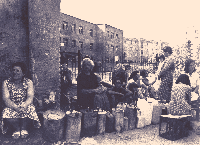
Immigrants and other refugees from different parts of former Yugoslavia, where war broke out, are in very difficult position, because most of them are of other ethnic background than Serb, so thy are unprotected and being helped by local citizens or humanitarian and women groups of Albanians.
Center for Women in Prishtina , provides for 47 families with 157 members humanitarian relief, medical care and councellings. Most of these women are of BosnianMuslim refugees from Focaend Bjelina, and they are being made forcefully register in order to return them back in Bosnia, but to be refugee once more, because their previous homes are now in Serb-held regions.